poem for oldest daughter

May 22, 2011

Distance

Distance does separate.

My heart aches to come visit,

Sit down, have a cup of coffee,

In your kitchen,

Talk as we go to the grocery store,

Which is when we truly share,

But there are 4 states

And 800 miles

Between us,

The sun rises here

36 minutes

Before it reaches you,

Your computer, depending on your paycheck,

May be on, or off,

And we do not do well on phones.

But there is no Winter where we are,

And Spring begins in February,

I have not scraped ice off the windshield of my car

Or felt my fingers go numb with cold

In three Decembers now,

There is something to be said for that.

And so we remain, alone, apart,

While grandsons grow up into men,

I am not there for “Grandma’s Day”

And we miss every game of their soccer season,

Life is always bittersweet,

Joy always comes mixed with tears,

We must gather the strength that lies within,

Trust in the Wisdom that brought us here,

Trust in the love that connects our hearts

In spite of anything.

backs

May 19, 2011

The spine is an amazing labyrinth of interconnected parts. When some of them don’t quite connect right or get twisted or bent a little wrong, boy do we know it!

I’ve started walking 3 miles a day, and now that I’m beginning to exercize regularly, my back is giving me fits. It just plain hurts. So now I am walking but in pain. Especially first thing in the morning.

Our son Jamal has some sort of genital defect, he’s been told, in his back or spine, which he has to gingerly care for, or he could be in very big serious trouble. He’s been in pain wrything on the floor before.  The last chiropractor said it was from one of his parents. I’m guessing it’s me.

what is a book?

May 18, 2011

What is a book? A book is knowledge, and knowledge is power. Especially today, when power has become = to being able to find information. Knowledge is at everyone’s fingertips. The key is being able to decipher all those millions and millions of gigabytes, decipher good information from bad information, reasoned information from babbling.

Today I go to my college, to remove books from the library. We are to remove as many books as possible, books not checked out in 10 years, books no longer having pertinent information, books in languages no longer taught at our college, BOOKS. Books books books.

We have a small library to begin with, something like 80,000 volumes. The library “space” is to be turned into a knowledge commons, a cool place to gather for students, with the Writing Lab and other helpful offices within its walls, plus: a coffeehouse.

I am right with the administration on this idea. I worked in a university library for 16 years and saw it evolve from a collector of volumes, to an interpreter of information mostly available online. Still, I love books. If there is anything I have trouble getting rid of, it is a book. An interesting, OLD book is even harder to get rid of. My office is a collection of books. Those by some famous theorist are the most valulable when old.

So this, today, will be a painful task, but also fun in some ways. It’s a treasure hunt. We are allowed to rescue titles that we want to keep back in our Departments. This is going to be a tough task.

I wonder about random musing of shelves in the future, times when you stroll through the shelves and randomly search, then find something wonderful that you never expected to find. What will that be like online? Somehow it just doesn’t “feel” the same to me. Is a relationship with a book you can hold in your hand, the same as a relationship with a gigabyte? That is something my great grandchildren and I will have to figure out.

pond life

May 13, 2011

Mid-May. Pond is alive with turtles and frogs. Walking, you see turtles thick all over the pond now. They have grown larger, most having 5-6 inch-long shells. They fear people and jump into the water if one comes near. They raise their heads out of the water to breathe and dive deeper when a human walks by.

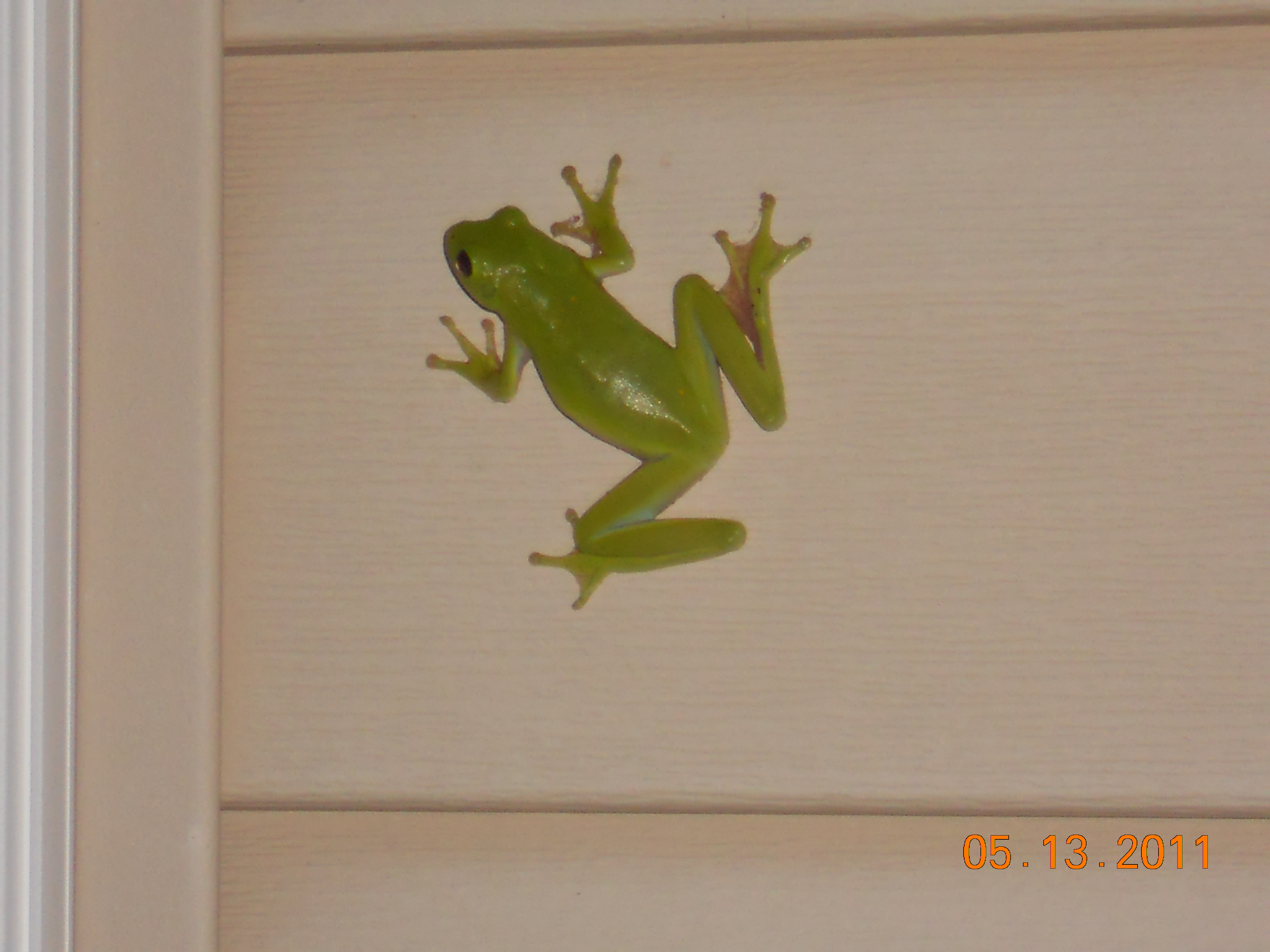
Frogs provide a symphony of sound in early to late evening. Some of them sound like Spanish dancers clicking castenadas, very fast. The sound is amazingly loud. A tree frog last night climbed up the outside door frame of our house, caught the Mayfly he was after & then jumped onto the house siding, his sticky-like paws enabling him to move sideways and finally down. My camera flash caught him in the dark night before he was gone.

    As I write this, thunder rumbles in the distance.

having the summer off

May 12, 2011

I’m a working class girl. My dad was a professor, but he was the first in his family to get a college education. I am the first woman. At home, he wore white t-shirts and gray pants. Every day. And just hung out with us. His father worked for the Monon railroad, as far as I know for his whole working life. My other grandfather worked as a car mechanic, a security guard, and during the depression for the W.P.A., building sidewalks on city streets. My grandmother took dresses from other relatives apart and reshaped them for my mother, during the depression. She was pretty good with that foot-operated sewing machine. She had 4 sisters. They were all sent to other people’s homes to work as domestic servants, when they turned 15. They all quit school at the age of 12. Besides my dad and myself no one else in my family has a Masters degree, that I know of, let alone a PhD.

For most of my life, I worked jobs that did not require a college degree. My very first job ever was being the hat check girl at a roller rink, age 15, on skates. From there I did the waitress gig at quite a few restaurants. Restaurant managers are some of the worst sexist jerks I ever met in my life. One constantly put the moves on me. Another beat his wife, and she would come in with bruises, expecting sympathy. Yet another’s wife was having an affair with the younger night manager. The manager came in one night, punched him out and fired him, then divorced his wife.

 Then I became clerical staff at a university library. As my research skills grew and I began to out-do the professional librarians and be requested by professors for assistance w/ their research, I decided I could do this for myself and ret’d to school. Besides, there was nowhere for me to advance to within the library system, and I didn’t want to get an MLS (Masters of Library Science).

During my 16 yrs. as library clerical staff, we never got the summer off. I’m used to 2 weeks paid vacation, and that was a privilege. We never had money for any planned getaway vacation, so I usually took a day or 2 off, here & there, all throughout the year.

To now be working a job where I get 3 months — the summer — OFF, is frankly, to be living a life of privilege. It *is* something that was within my own family of origin, as my own father took us on a 3-4 week annual family vacation. We camped in tents, but we traveled, almost always west. I’ve had my August birthday in the Grand Canyon, Yosemite National Park, and in Mexico. I’ve seen a bullfight, and I’ve driven into the California Redwoods, where trees made us feel as big as an ant.

But for my working lifetime, I’ve never had my own summers off. The school year is so stressful & hectic, it’s almost a necessity. I have time to breathe, to stress down, to contemplate, to organize. I have summer projects, including a journal article and family history research. But my time is my own, and I am setting no alarm clock. I get paid very little for the amount of education I have and the incredible amount of work I do during the semester. So I see this as a wonderful little “perk” almost necessary to this job. However, I also know just how much this sets me apart from most of the global world. It is an incredibly privileged life.

James Agnew’s 1st family!

May 2, 2011

James Agnew, my great-grandfather, was married first to Mary Caroline G (not sure if it’s Gross, Gorp, or what), in August of 1863. They were married in New Albany. This is THE place for our relatives, that’s for sure! Most of them still live there. James & Mary had 2 girls, Annie in 1865, Olith in 1867. I’ve never heard that name, but she evidently went by “Ollie”. Both Annie and Ollie survived to adulthood and were married. I don’t have that info. yet. Annie is listed as a surviving SISTER in William Robert’s obit. William Robert is the eldest child of James and Carrie, his 2nd wife & the marriage we all came from.

James went by “James A.” in the 1st marriage. So his middle name starts with A. Just another clue.

Mary dies in 1874 at age 31. He then married Carrie Bybee, my great grandmother, in 1879. My grandpa John Wesley is the youngest, along w/ his twin sister, from their marriage.

on the trail of James

April 27, 2011
James Agnew, my great grandpa married Carrie, my great grandma in 1879. There was an age difference between them. I had an earlier record of a James Agnew in the same place, New Albany, married to “Mary C” in 1870, & they had 2 children, ANNIE age 5 and CLITH age 3. I never knew if they were an earlier family? Did something happen to them between 1870 & 1879?
 
We  just found an obituary for the eldest child of James and Carrie, (William Robert). In the surviving relatives, it lists a SISTER, ANNIE. This means that was the same James in both marriages.
 
so what happened to his 1st wife and son, Clith? Interesting. The mystery deepens.

new family history

April 26, 2011

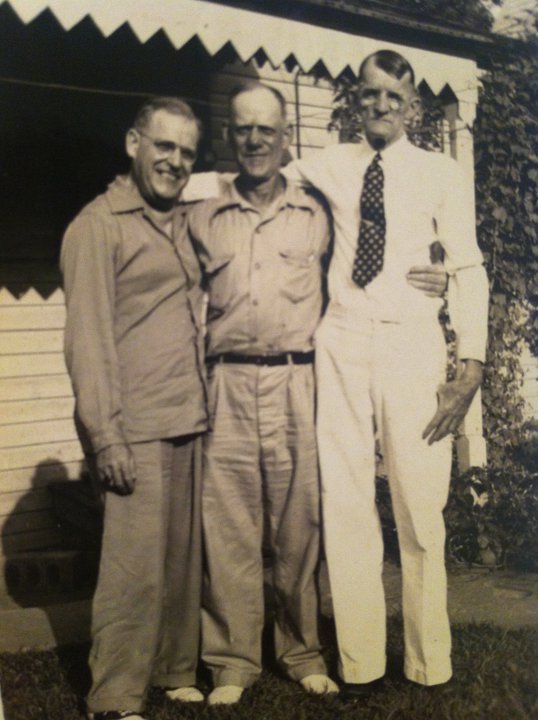
John Wesley on L, Alfred Edward, Frederick Louis, brothers.

status in your home neighborhood

April 26, 2011

In my sociology of poverty class, we have done a reading on status within a trailer park. We have also read sections of “Code of the Street” about inner city Philadelphia, where the people themselves call each other either “decent” or “street”. Then I asked the students how stratification existed in their home neighborhood where they grew up.

In my home neighborhood, status was evident in a number of ways. First, there was the one family on the block, a Catholic family, who bought 2 neighboring houses & then built a mid-section to unite them. They had THE BIGGEST house on the block, and 11 kids. Not only that, they had money. When you went into their house, they had a stereo speaker system where music played from room to room, and the parents could talk into it from the kitchen or living room, and reach any one of the many bedrooms and carry on a conversation with whoever was there. Now that was status in the late 50s to early 60s.

There was a division between the lower part of the street and the upper. The upper part, my family’s area, had larger houses, 2-3 stories, and sometimes a screened-in porch. The yards were kept up and trimmed, with nice green grass, although not quite up to the bright green yards people have today through a lawncare company. Our house was 3 stories. We also had a full basement we roller-skated in, on rainy days, it was so large. My dad had an “office” down there, and my mother had a washer & dryer. My older brother also carried out science experiments down there and later made films.

Down the street, the houses became smaller and the families were working class. We knew the difference, even as kids. When we walked to school, which we did every day, we saw the change occur. Poverty showed up a little farther on, just a few streets away. The kids there never had anything, and their hair was unkept, the girls’ hair may have been matted or wildly natural curl, not neatly bobby-pin curled. They didn’t have their own bedrooms either. If you went inside their houses, they felt “dirty”. They didn’t have the giant dining room with mahogany or cherry-wood table sitting there like a trophy you could never touch.

Our mothers were home. We came home for lunch. Working class kids had to go home w/ someone else for lunch, as their mothers were working.

As a kid, if you had a COOL BIKE, you had status. For us, it was a stingray-seated bike. If you had roller skates with a key, you were cool. We created our own private, membership by invitation only clubs of kids. If you were “cool” you could join our club. We rode our bikes around the neighborhood and climbed trees, sometimes finding a little nook or cranny we called our “hideaway”. This is where our club would gather and meet, like a secret society.

As a kid, I always played w/ the poor kids at school, but my mother would never let me go to their houses much after school. Unless their mom happened to be the Girl Scout leader, and I would go there for a weekly GS meeting, but then come home.

I never fought much. I was never a fighter, in any way. Occasionally, someone attacked me, as I vaguely recall. In those instances, I would throw a punch & then duck out. I can remember being really angry with some close friends. We would VERY rarely physically fight, but would yell and send them home, not allow them to come in our house, gang up with other kids to exclude them, those kinds of games. More than likely, I was the one being excluded. I tended to be really close with just a few girlfriends. When they turned against me, I was crushed, & then my parents would go to bat for me & tell me how they weren’t anything. I was a fairly lonely kid. 🙂
the road much travelled

April 21, 2011

My husband and I soon leave for Indiana over Easter weekend. I hate the drive and especially hate driving all night. But we have no choice this time. A 3-day weekend with a 10-11 hr. drive isn’t that long of a time.

The Road Much Travelled

Soon, we leave,

after a full day’s work,

put suitcases in trunk,

laptops in car,

and hit the road much travelled.

I will grade papers

as you drive,

for when we return,

Finals begin,

the end to another semester.

We leave the warmth of the Carolina sun,

where Spring begins in February,

flowered trees now have diminished blooms,

and Summer is in the air,

We ride the road much travelled,

back to the north,

where corn will be sprouting,

but not yet high,

where the land is all wide open spaces,

and huge expanse of sky,

where the roundness of the earth

is seen and felt

in the sky’s arching down

to kiss the horizon,

where my heart still quivers

for 2 grandsons and a daughter,

and a son’s love beckons us,

come back to our roots,

on the road much travelled,

to the place we call home,

not the land of cotton, forest and swamp,

but the land of cornfields and soybean crops,

where cities have more than a million folks,

and people know Chicago,

where ancestors fought on the side of the north,

and no Confederate flags 

grace the statehouse lawn.