Archive for the ‘family tree research’ Category

Noyes Earl Reid

December 29, 2025

Researched my Grandma Mary’s brother, whose names was NOYES EARL REID.

They moved around some. He starts in Bedford & is buried in Bedford. Here is the timeline: Born Aug.25, 1895. (Our grandma Mary was b.Dec. 1899.)— In 1913, he is in Bloomington & was taken to a hospital for “ptaline poisoning from a ham sandwich” (news story). in 1916 he is at 411 W. 3rd St., Bloomington, and registeers for military, saying a reason he can’t serve is supporting his mother Marries in 1918 (lady named Madelin). In 1920, they are living in Indianapolis with HER parents at 1807 College Ave., Indy. In 1930 they are back in Bloomington living at 1303 S. Walnut St. where he works as a fireman and for the RR (railroad). By 1940 they have ret’d TO BEDFORD and live at an address that doesn’t exist anymore: 1021 “R” St. (near RR?) He is working as a “painter, contractor, for Steel Towers). In 1950, they are living at 2130 “P” St. (near 22nd St. it seems) & he AND his wife are working in paint sales at a paint store. (Some years missing here…) At his death in 1983 of leukemia, they were at 1912 19th St., Bedford. Looks to me like it’s maybe at a Boys & Girls Club address today with a parking lot.

Noyes and Madelin have 2 sons, Phillip Earl (1921-96) and Richard Joseph (1927-2002).

Phillip Earl marries Maralou Shakleford and they have a daughter, Martha Diane, and a son, John Curtis (b.1954). Martha Diane marries Steven Barry Geller. There is one son mentioned for them, Max M. Harris Geller. I wonder if he is a son from a previous marriage for Steven, just because of the middle name Harris. He is listed in a newspaper obit. The obit also confirms her brother John Reid.

Richard (1927-2002) marries Ramona Colleen Gipson and they later divorce. They seem to have one son named Joseph S. Reid. Richard marries Celia Lynn _____ and they seem to have 2 sons, Alexander 1988, and Andrew 1992.

2 immigrants: Gerrit and Mathilda

June 14, 2025

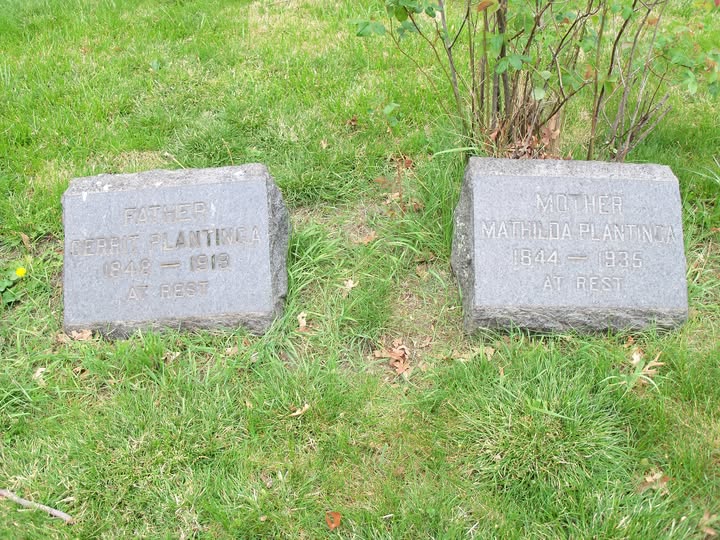
2 immigrants: Gerrit Gerrits Plantinga and his wife, Mathilda (“Tilke”) Wobbes van Vliet. Gerrit was born 28 Dec. 1847 in Stiens, the Netherlands, which is part of Friesland, a coastal area of Netherlands. He was my great-great-grandfather and immigrated to America in 1890. His wife, “Tilke”, was born 9 Dec. 1843, in Hallum, another city in Friesland. Gerrit and Tilke had 8 children, all born in the Netherlands before they immigrated to America. (SO IF CONDITIONS IN THEIR LIFETIME WERE LIKE THOSE OF TODAY, THEY WOULD ALL FACE DEPORTATION OR IMPRISONMENT JUST FOR COMING HERE.) Their 3rd child was Wopke (later called William) Plantinga, my great-grandfather, father of my Grandpa George. Wopke had immigrated 8 yrs. before them, in 1882. Gerrit and Tilke arrived on Oct.18, 1890 with destination city being the neighborhood of Kensington, on the south side of Chicago. They probably had other relatives already there since they listed a neighborhood of Chicago. Four of their younger children traveled with them: Antje (Anna), Bootje (Bertha), Lieuwkje (Lucia), and Rinske (Rosie). In 1910, Gerrit and Matilda lived on 103rd St., Chicago, and he worked as a laborer in a “car shop”. His language is listed as English, Matilde’s as Dutch, so she probably never learned to speak English well. They stayed in Chicago, died & were buried there, in Mount Greenwood cemetery, Cook County, IL, Gerrit in 1919, Mathilda in 1935.

cfblack, 6-14-25

AL’s Indian GGGrandmother

August 18, 2020

From family stories, we believe it is very likely my husband’s GGGrandmother was Native American, or Indian. (Many Native peoples call themselves Indian). Her name was Julia Kenern. She had a first marriage because she had other children when she married AL’s GGGrandfather, Tom Haniford (Hannaford, Hanaford). He spelled it Hannaford. The confusing thing is, Tom’s first wife was ALSO named Julia but her name was Julia Corkery.

Julia Kenern and Tom Hannaford married on 8 Nov. 1869, in Warren County, Indiana. They then took up residence in Fountain County, Indiana. They both had children from first marriages in the household but had ONE daughter of their own, Johanna. Johanna was born 2 Jan. 1876. BOTH Thomas AND Julia Kenern Hannaford were dead within a year or two of her birth. I have NEVER managed to find death records or burial sites for either of them. Johanna was herself taken in by older half-siblings. We find her in a school picture when she was around age 14. Most of the 1890 census was lost in a fire. Johanna married John Morgan in 1897.

The story of Julia Kenern being Native is that there was a picture of them on their wedding day, or at least of her on her wedding day & she had a beautiful buckskin dress on. Aunt Lucille told us she saw the picture and HAD the picture, but made the unfortunate decision to leave it with JULIA (daughter of Johanna), Lucille’s mother. Julia Black tore the picture up and said, “Nobody needs to see that.” We have never found another COPY! FRUSTRATING.

Judging from where they married and where they lived, if she were Native, she probably was MIAMI. Here is a website that talks about the Miami tribe location: http://www.newsbug.info/wcinews/indian-reservations-in-warren-county/article_39506612-6343-11e7-92cc-b34f30849806.html

AL has a few DNA relatives that now show up on Ancestry which gave us the exact birth & death dates for Thomas Hannaford. I have messages out to them asking them where they found the dates.

Thomas named his first son Timothy. On ancestry, Tom Hannaford’s father’s name in Cork Ireland, was Timothy Honiford. (another spelling of last name)


Cena Brink

August 11, 2020

Cena Brink, my grandmother, was born somewhere within the Wea Plains, Tippecanoe County. She always said she was from “the Shadeland area”. Her family evidently lived on a farm somewhere in this area. There are 2 small towns of West Point and Shadeland. She attended West Point, Indiana schools.

The Wea Plains has a historical marker and is one of the few sites left that show the Indiana plains. The Wea Indian tribe claims this area as their home. My Dutch ancestors would not have cared about their heritage or the value of this land to them. In their time period, they were given rights to settle this area and the Wea continue their struggle to be officially recognized as a tribe, by the U.S. government.

Cena was the 5th girl born to Martin and Trijntje Brink. (They had one boy, Henry, who did not live long.)

Cena loved school but had to quit at age 12 to do domestic work and assist her family’s income. This is what poor whites did in those days. She was very sad to quit school, and continued to recite the state capitals of all 50 states to us for the rest of her life.

— I write this because in doing some family history work today, it took some time to sort out her birthplace.

ethnicity

July 22, 2020

Different DNA test find this for me:

ANCESTRY:

78% England, Wales, NW Europe

13% Germanic Europe (i.e. the Dutch)

6% Norway, Iceland

3% Ireland, Scotland (BIG WHOOP).

FAMILY TREE DNA:

78% British Isles

15% Scandinavian (Norway, Sweden)

4% Southeastern Europe (Italy, Greece…)

<1% Ashkenazi Jew

23ANDME:

35% French & German (the Dutch are here)

30.6% British & Irish

  • areas where my ancestors probably lived in the past 200 years: London, Glasgow (northern Scotland), Donegal Ireland (up north near Larne, home of some Agnews who are Irish), a couple other areas of southern Ireland.

9.7% Scandinavian

.5% Southern Europe

.1% Italian

.1% West Asian & Northern African


I think I inherited the Agnew Norman DNA (Scandinavian) from way back. A lot of the relatives I’ve traced (Owens, Hunter, & others) from my dad’s side go back to Welsh or English, so that makes sense. Where our Agnew line falls, I still don’t know.


to James Agnew from Cincinnati

July 19, 2020
To my great-great-grandfather.
I will find you.
I will find you out,
And report whatever secret keeps you hidden from view.
I will find you and OUT you,
for all the world to see.
You can’t hide forever,
though you lied on the census,
told different stories, about who you were.
We will find you,
whether it is now or later,
the truth will come out,
it will be told.
Because truth has a way of wiggling itself
and causing an itch and a burn.
We will find you, because we deserve to know,
who you and your father were.
We are a part of you,
we carry your blood,
your story lies in our DNA.
And when we finally meet, I will tell you myself,
you should never have caused
so much unnecessary pain.
          cfblack, 07-19-2020

the Dutch

July 12, 2020

The Dutch are great. They kept birth records in the 1600s. They have very interesting names. 🙂

So my grandmother Cena was the 5th daughter and 5th child born to Martin and Trena Brink. Except Trena’s name was actually Trijntje in Holland, the homeland.

Trena’s parents were Henry and Flora Van Shepen. Except their real names were Hendrik Van Shepen (1822-1915) and Froukje Koov (1820-1902). (Some report it as Kooy). I remember my grandparents (Cena and George) making the “v” sound so I use Koov.

Just discovered Hendrik’s parents were:

Feike Hendriks Van Shepen

Trijntje Peters Hak

so it appears that Hendrik and Froukje named their first daughter (and 3rd child) after Hendrik’s mother Trijntje…… which is impossible to pronounce as written. I hear it as “Traintjay”).   Trijntje Brink, my great-grandmother.

The story of Martin Engbringhof

May 17, 2020

The story of Martin Engbringhof, my great-grandfather

Martin was born in the Netherlands on August 20, 1857, 96 years almost to the DAY prior to my birth Aug. 19th, 1953. The family is from the part of the Netherlands called “Friesland” so in all likelihood they spoke “Frisian” and not “Dutch” at home. Friesland is a northern state of the country of the Netherlands, on the coast. Martin was born in St. Jacobiparochie, Het Bildt, Friesland, the Netherlands. His FATHER, Martin Martens Engbrighof, was born in Marrum, Ferwerderadeel, also in Friesland, and his MOTHER, Feikje Dirks Koopma, was born in Frouwenparochie, Het Bildt, Friesland. So we are definitely Frisian.

From what we know, Martin had a brother born 2 years before him, but he only lived for 2 years. His name was Marten spelled with an “e”. Then MARTIN was born the same year that his older brother died. Then he had a younger brother, Dirk Martens, born in 1858 but he died that same year. Then another boy was born 7 years later, in 1865. They named him “Dirk” also. He lived a long life of 74 years. Martin and Dirk had 2 younger sisters, first Sjoukje, born in 1868 and she lived for only 29 years. The baby girl, Antje, died the same year she was born in 1871. So out of 6 children born to Martin’s parents, only himself and his brother Dirk lived a long life.

Martin got married on June 5, 1879, to a woman named Trijntje van Schepen. They were both 21 years old. Their first child, a girl named Fekje, was born 3 months later on September 27, 1879. The next year, on New Year’s eve, Dec.31, 1880, they had another baby girl named Flora. It appears Martin made a few trips back and forth from Holland to America, but at any rate, by Jan. 1st, 1883, they lived in Lafayette, Indiana, United States, and in 1884, their 3rd daughter, Martha, was born there in October 1884. After coming to America, Martin changed his last name from “Engbringhof” to “Brink”, and their daughter, Fekje, became “Fannie”. I remember Great Aunt Fannie at family reunion picnics. She was always very nice to kids, but wore old Dutch black dresses that hung down low. In 1885, Martin’s only son, Henry, was born, but he only lived one year. At that time, Martin worked at a place called “Car Works” and was listed as a “laborer”.  (This doesn’t quite make sense to me because what cars existed in 1885? This is what ancestry.com says is in the Lafayette city directory for 1885-1891.)

Another daughter, Clara, was born in 1889 and finally, MY GRANDMOTHER, Cena, in 1891. At the turn of the century, by June 1900, they lived in the country near Lafayette, in “Wayne Township”. Martin was 42 years old and his wife, who now was named Trena and nicknamed “Kate” was also 42. Living with them were their youngest 3 girls, Martha now 15, Clara age 11, and “Sennie” age 8. From Cena’s stories, I know that at this age, Sennie was going to school and loved it. She had to quit school to never return to it by 6th grade. She never wanted to quit school but she had to go to work in other peoples’ houses, doing cleaning services, AND, give the money back to her father, Martin Brink. For the rest of her life she was very proud of the fact that she knew ALL the state capitals, and delighted in us, her grandchildren, asking her to name them when she was an older woman. I feel sad that she had to quit school, don’t you?

In this year of 1900, Martin said he immigrated to America in the year 1882. His work is listed as “farmer” and he rented, not owned, the farm. It was listed as farm #11. They also had 2 men working for them, who were listed as servants, but “white”. They were Dutch also. At some point he became an American citizen, but I don’t know when that was.

In 1910, the family was still out in Wayne Twp., but by 1920 they had moved back into town. By that year, they lived at 1709 Hartford St., which is in the same neighborhood my mother was born in, and the neighborhood where my father and mother met each other. Martin is 63 years old and listed just as a “laborer”. All the girls are now married and living apart from he and Trena. Ten years later they are still in this house but he is no longer working. Trena is sometimes called “Catherine” or “Kate”. She only lives one more year, passing in 1931. She died by falling down a basement stairway and cerebral hemorrage! And THEN, four years later, Martin marries Kate’s SISTER, Flora! They were married in 1935. I noticed in a wedding announcement that only a couple of relatives came, and my grandmother Cena did not. She told me when I was a child that “he needed somebody to cook for him”. That is one of the family stories. It is interesting that FLORA was also the name of his first wife’s mother.

Another not-so-complimentary story of Martin is from my great-aunt Tina. When Tina was a little girl, she was looking at herself in a handheld mirror, and Martin came up behind her and said, “You look in that mirror too long and you will see the DEVIL in it!” and scared her. Martin was a member of the Dutch Reformed church, a church in the Puritan tradition. No dancing, no frivolities, just serious work.

Martin Brink only lived for one more year, passing at age 79, on Nov. 1st, 1936. He is buried next to his first wife, Trena (Kate, Catherine, Trejntje), in Springvale cemetery in Lafayette. I’ve been there, the gravestone is a dark rose color, in the back of the cemetery on the left side, up a small hill. His death certificate lists “myocardial….something” and arteriosclerosis as the problem. Heart attack, hardening of arteries. At his death, he left quite a family with 17 grandchildren and also I think 6-7 great-grandchildren.


66 years

August 20, 2019

I have been on this planet 66 years, as of yesterday. Here are a few things that tell me how much I have experienced and what changes have occurred in those years:

  • When I was a little girl, we had one phone in the house, near the kitchen. I even remember some of our phone numbers. One was HA 31931. Numbers now have 10 numbers to a phone number. Ours had 7.
  • When we wanted to call someone, we would pick up the receiver and listen. If we heard someone else talking, that was the people sharing our “party line” and we had to hang up until they were done, then make our call.
  • I remember when calculators first came out. I was starting college. They were expensive.
  • My first car was a VW bug, original, green, with clutch and shifting gears. I did everything I could do to avoid stopping on a hill. If you shifted and “missed” the next gear, it could just roll backwards into the car behind you.
  • Certainly, there were no computers, no video games. I remember computers coming into peoples’ homes. I remember some kind of HUGE computer being rolled into Purdue libraries. I remember the taking down and dismantling of the card catalog. I took the 3X5 cards with my dad’s Masters thesis and PhD titles.
  • For my 15th birthday, I got a polaroid “Swinger” camera.
  • I used to put curlers in my hair and sleep on them. When I was a little girl, my mom wound my hair into little curls and pinned them to my head with bobby pins. We took them out in the morning.
  • The Beatles came out when I was about 13 yrs. old. I had a huge picture of Paul McCartney on my bedroom wall. For my 15th birthday, my dad took my sister and I to a Beatles LIVE concert at Kennedy stadium. Thunderstorms threatened all evening and John Lennon pointed his guitar toward the clouds and acted like he was shooting at them. I screamed through most of the concert. My dad was so embarrassed, he moved my sister and himself away from me and another girl who decided to scream together for the duration. We bought their music on “record albums”.
  • I was sent home from high school one day when some girls and I decided to wear jeans to school, to protest not being able to wear PANTS. Even in the coldest of winter days.
  • Saturday mornings were the only time we could watch cartoons on TV. We would wake up and camp out in front on the television all morning until lunch-time. The final shows were Sky King and My Friend Flicka.
  • The Wizard of Oz movie came on TV once a year. There were no home movies, no DVDs.
  • I was not allowed to see Cleopatra in the theater because it was too adult.
  • Candy bars were 5 cents. Cokes were 10 cents.
  • In a drugstore down the street, they sold penny candy. One of the candies was in the shape of a baby, we called them “Tar babies”. They used to be called something else.
  • Pres. Kennedy was shot when I was in 5th grade. Our teacher came into the class upset and said he had been shot. A little later she returned, saying, “The President has died,” and we were all sent home.

Trijntje served tea

July 20, 2019

In the back seat of the car,

all the way to South Dakota,

Trijtnje served tea.

“Cup ee tay ha?” she would say, and smile,

“Kopke tee?” in Frisian Dutch.

Always a gracious host,

she passed this trait to her daughter,

and my grandma passed it to me.

You never take a drink

without offering to others,

You always have a treat,

some coffee or tea,

They took her with them to the Dakotas,

to see relatives who hated the Indians,

We may be poor,

but we’re not “them”,

not Black or Indian,

thanks be to God.

They came to America and learned its ways,

Learned who was who, and what was what,

Grandma Trijntje served tea in the back seat of the car,

only there was no tea,

it was all imaginary,

just like those boundaries they put between people,

that America taught them were real.

cfblack     07-20-2019